
 Tiếng Việt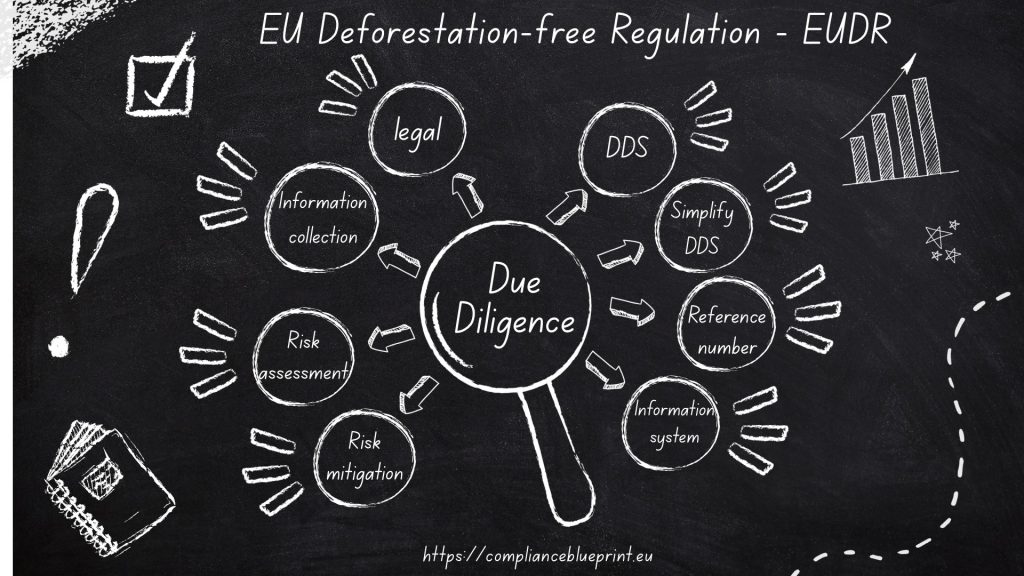
Introduction
The EU Deforestation Regulation (EUDR) requires companies to prove that certain products are deforestation-free and legally produced. At the heart of this is a process called due diligence. Understanding what due diligence involves is essential for complying with the Regulation.
This article explains the three key steps you need to follow to meet EUDR’s due diligence requirements.
What Is Due Diligence?
The EUDR doesn’t define “due diligence” in a single sentence, but it outlines what a due diligence statement must include: proof that you’ve followed a process to minimize the risk of non-compliant products.
This process involves three parts:
- Information collection
- Risk assessment
- Risk mitigation
In short, you must gather detailed information about your product’s origins, assess the risk that it comes from deforested or illegal sources, and take action if any risk is identified.
Step 1: Information Collection
According to Article 9 of the EUDR, you must collect and keep the following information for at least five years:
- Product description (trade name, type, scientific name for wood)
- Quantity (net mass, volume, or number of items)
- Country and specific region of production
- Geolocation coordinates of all production plots
- Harvest date or time range
- Contact details of your suppliers and buyers
- Verified evidence that the product is deforestation-free and legally produced
⚠️ Important: If you cannot obtain this information, you cannot place the product on the EU market or export it. Doing so could lead to sanctions.
Step 2: Risk Assessment
Once you’ve gathered the data, you must assess whether there’s a risk the product is non-compliant. Article 10 sets out several factors to consider, such as:
- The country’s risk level according to the country benchmarking
- The country’s deforestation or forest degradation risk level
- Indigenous peoples’ rights claims in the area
- Corruption, poor law enforcement, armed conflict, or human rights violations in the source country
- Supply chain complexity and traceability challenges (i.e. risk of mixing)
- Evidence of document falsification or fraud
- Any official concerns raised about the area or supplier
You must document how you evaluated these risks. Products can only enter the market if you conclude there is no or negligible risk.
Step 3: Risk Mitigation
If your risk assessment finds more than a negligible risk, you must take action before proceeding. Article 11 suggests measures like:
- Requesting more information from suppliers
- Conducting independent audits or inspections
- Working with suppliers to improve compliance (e.g., training, investments)
You must have policies and controls in place to manage these risks, including appointing a compliance officer and conducting internal audits (if you’re a non-SME operator).
Why This Matters
Due diligence under EUDR is not just a paperwork exercise. It’s a legal obligation — and failure to comply can block your products from the EU market and expose you to penalties. By understanding and implementing the three steps, you’re not only protecting your business but contributing to global efforts to stop deforestation.
Conclusion
EUDR’s due diligence requirements may seem complex, but they follow a clear structure: know where your product comes from, assess the risks, and act to eliminate them. Start building robust processes now to ensure compliance by the enforcement deadline.
