


 Tiếng Việt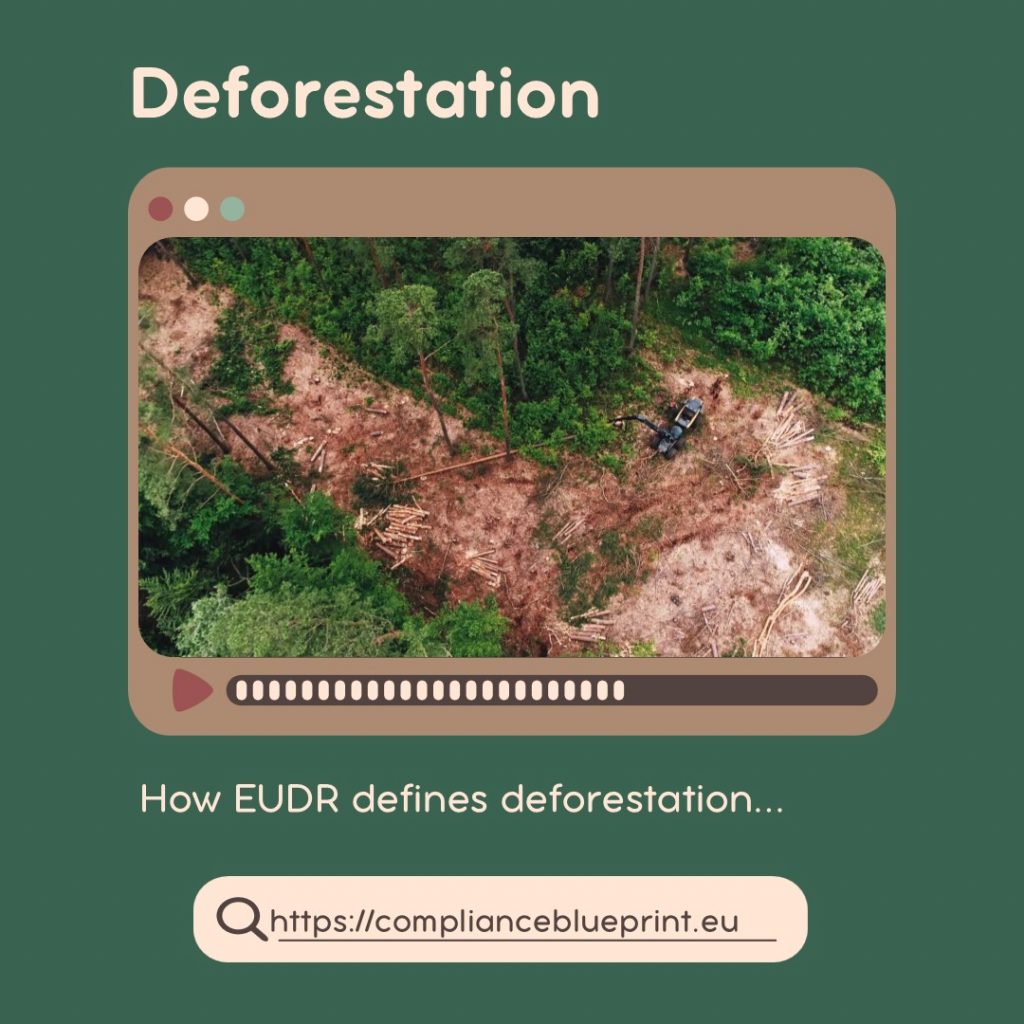
Summary:
This blog post explores how the EU Regulation on Deforestation-Free Regulation (EUDR) defines deforestation, highlighting how it differs from the broader and widely used definition by the Food and Agriculture Organization (FAO).
While deforestation may seem like a straightforward concept, the EUDR applies a more targeted interpretation that focuses specifically on agricultural activities linked to seven key commodities. Understanding these distinctions is essential for anyone involved in compliance, sustainability, or forest-related policymaking. This post breaks down both definitions, compares their scope, and clarifies what the EUDR does—and does not—cover.
Background:
Regulation (EU) 2023/1115—better known as the EUDR—aims to ensure that certain commodities entering or leaving the EU market are not linked to deforestation or forest degradation after 2020. The regulation mandates operators and traders to geolocate production areas and assess deforestation risks.
At the heart of the EUDR is a crucial concept: deforestation. While the term may instantly conjure images of cleared forests, the EUDR uses a very specific definition—one that differs significantly from broader international definitions like that of the Food and Agriculture Organization (FAO). Understanding this distinction is key to interpreting the regulation and its implications.
The EUDR’s Narrow Focus
The EUDR’s definition of deforestation is limited to agricultural conversion, specifically to land-use change driven by the cultivation or production of seven key commodities: cattle, cocoa, coffee, oil palm, rubber, soy, and wood.
Why these seven? Because they represent the leading causes of global deforestation. According to FAO and UNEP (2020), large-scale commercial agriculture—especially cattle ranching, soy, and oil palm—accounted for 40% of tropical deforestation between 2000 and 2010. Local subsistence farming contributed another 33%. The EU has targeted these commodities based on their outsized impact.
However, this narrow scope means that the EUDR does not address deforestation driven by other land-use changes such as mining, infrastructure development, or urban expansion.
Comparing Definitions: FAO vs. EUDR
Here’s a side-by-side overview to illustrate the contrast:
| Aspect | FAO | EUDR |
| Deforestation definition | Deforestation is the conversion of forest to other land use independently of whether human-induced or not (FAO, 2020).
|
Deforestation means the conversion of forest to agricultural use, whether human-induced or not;
|
| Drivers | Conversion of forest to any other land use, regardless of cause
Inclusive of agriculture, mining, construction, urban development, etc. |
Conversion of forest specifically to agricultural use linked to the seven commodities
Limited to agriculture-related drivers involving specific commodities |
| Forest Definition | Land over 0.5 ha, trees >5m, canopy cover >10% (excluding agricultural/urban use) | Adopts FAO’s definition, |
| Exclude:
– Plantations of agricultural tree crops (such as oil-palm plantations and orchards); – urban parks
|
– Agricultural plantations where trees stand in agricultural systems such as: fruit tree plantations, oil palm plantations, olive orchards, agroforestry systems. => Essentially all plantations of relevant commodities other than wood |
|
| Include:
– Various types of planted forests (incl. rubber plantations) |
– Do not include rubber plantation |
|
| Forest Degradation | Not explicitly treated as deforestation, but rather as a separate concept. | It is considered a form of deforestation if it involves conversion of primary/naturally regenerating forests under the following scenarios:
a) primary forests or naturally regenerating forests into plantation forests or into other wooded land; or b) primary forests into planted forests. |
Forest Degradation under the EUDR
The EUDR provides a distinct definition of forest degradation, which covers structural changes to forest cover involving the conversion of primary or naturally regenerating forests into plantation forests, planted forests, or other wooded land. Under the EUDR, wood harvested from forests undergoing such conversions is considered non-compliant.
Specifically, the EUDR considers wood non-compliant if it is harvested from forests that have undergone any of the following conversions:
1) Conversion of primary forests into plantation forests,
2) Conversion of primary forests into other wooded land,
3) Conversion of naturally regenerating forests into plantation forests,
4) Conversion of naturally regenerating forests into other wooded land,
5) Conversion of primary forests into planted forests.
These restrictions aim to preserve the ecological integrity of forests by preventing the loss of natural forest characteristics through degradation.
Why Only One Comparison?
While many institutions define deforestation, this post focuses on the FAO’s definition due to its broad recognition in scientific, academic, and policy circles. You’ll find a few other definitions listed at the end for reference.
In Conclusion
EUDR’s strength lies in its targeted approach. But this also means it doesn’t address the full scope of global deforestation drivers. For policymakers, businesses, and stakeholders, understanding the limits and nuances of its definition is essential for compliance and for developing more holistic strategies against deforestation.
Other deforestation definitions
| Accountability Framework Initiative (AFI) | Deforestation: Loss of natural forest as a result of: (i) conversion to agriculture or other non-forest land use; (ii) conversion to a tree plantation; or (iii) severe and sustained degradation. |
| Global Forest Review (GFR) | Deforestation: The change from forest to another land cover or land use, such as forest to plantation or forest to urban area. |
| Hansen et al., 2013 | Deforestation is the conversion of forest to other uses such as farming land, formally defined, for example, as a reduction of 50% of the tree-cover
|
References
AFI, no date. Deforestation and conversion. Accessed 25 May 2025.
FAO, no date. Chapter 2 Forests and trees provide vital goods and ecosystem services but are undervalued in economic systems. Accessed 25 May 2025.
FAO and UNEP, 2020. The State of the World’s Forests 2020. Forests, biodiversity and people. Food and Agriculture Organization of the United Nations (FAO) and United Nations Environment Programme (UNEP). Accessed 25 May 2025.
GFR, no date. Data & methods: Key terms and definitions. Accessed 25 May 2025.
Hansen et al. (2013). High-Resolution Global Maps of 21st-Century Forest Cover Change. Science 342, 850-853.
