

 Tiếng Việt
Forests play a vital role in supporting thriving economies and societies. They regulate water supplies and provide essential resources for people. It is also home to pollinators on which food systems depend. Forests are also important as carbon sinks, helping to mitigate climate change. However, deforestation threatens these benefits and endangers our economies and societies.
Halting deforestation is essential for the world to achieve its socio-economic development, biodiversity and climate change mitigation goals. However, the world is not on track to stop deforestation by 2030 (UNREDD, 2024). That is why it is great to see the European Union taking the lead in the fight against deforestation by adopting the EU Deforestation-free Regulation (EUDR, Regulation Regulation (EU) 2023/1115).
EUDR sets out rules to ensure that supply chains for key commodities are free of deforestation and forest degradation after 2020. The seven commodities covered by the EUDR are cattle, cocoa, coffee, oil palm, rubber, soy, wood, and their derived products. Companies in the EU are required to exercise due diligence to demonstrate that (1) the products are deforestation-free and (2) the products have been produced in accordance with the relevant legislation of the country of production.
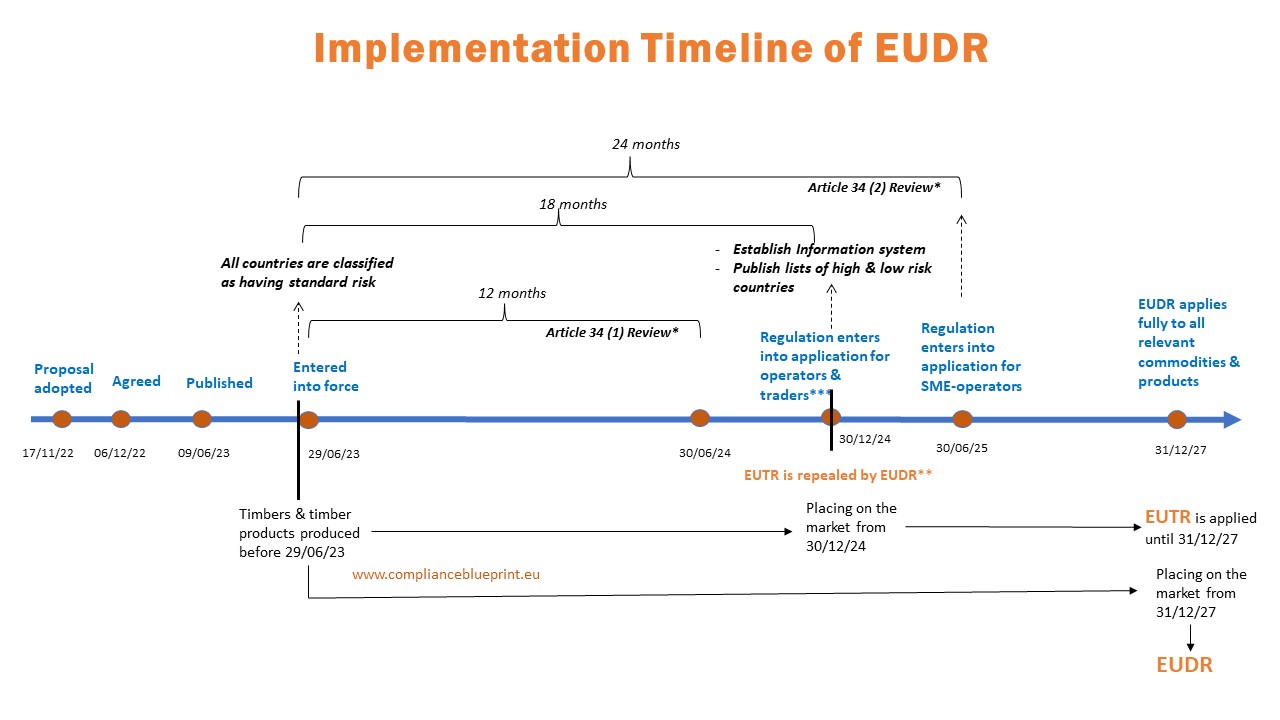
I have created the following flow chart to summarize the key dates for the implementation of the EUDR.
Explaination:
Article 34 (1)*
By 30 June 2024, the Commission shall present an impact assessment accompanied, if appropriate, by a legislative proposal to extend the scope of this Regulation to include other wooded land and the cut-off date.
Article 34 (2)*
By 30 June 2025, the Commission shall present an impact assessment accompanied, if appropriate, by a legislative proposal to extend the scope of this Regulation to other natural ecosystems, including other land with high carbon stocks and with a high biodiversity value, such as grasslands, peatlands and wetlands and the cut-off date. The review shall also address the need and feasibility of extending the scope of this Regulation to further commodities, including maize.
EUTR**:
Except for timber and timber products produced before June 29, 2023 and placed on the market from December 30, 2024. EUTR will continue to apply to these products until December 31, 2027.
Enterprise classification***:
According to Article 3 of Directive 2013/34/EU of the European Parliament and of the Council, undertakings and groups are categorised as:
1. Micro-undertaking are undertakings which on their balance sheet dates do not exceed the limits of at least two of the three following criteria:
(a) balance sheet total: EUR 350 000;
(b) net turnover: EUR 700 000;
(c) average number of employees during the financial year: 10.
2. Small undertaking shall be undertakings which on their balance sheet dates do not exceed the limits of at least two of the three following criteria:
(a) balance sheet total: EUR 4 000 000;
(b) net turnover: EUR 8 000 000;
(c) average number of employees during the financial year: 50.
Member States may define thresholds exceeding the thresholds in points (a) and (b) of the first subparagraph. However, the thresholds shall not exceed EUR 6 000 000 for the balance sheet total and EUR 12 000 000 for the net turnover.
3. Medium-sized undertakings shall be undertakings which are not micro-undertakings or small undertakings and which on their balance sheet dates do not exceed the limits of at least two of the three following criteria:
(a) balance sheet total: EUR 20 000 000;
(b) net turnover: EUR 40 000 000;
(c) average number of employees during the financial year: 250.
4. Large undertakings shall be undertakings which on their balance sheet dates exceed at least two of the three following criteria:
(a) balance sheet total: EUR 20 000 000;
(b) net turnover: EUR 40 000 000;
(c) average number of employees during the financial year: 250.
5. Small group shall be groups consisting of parent and subsidiary undertakings to be included in a consolidation and which, on a consolidated basis, do not exceed the limits of at least two of the three following criteria on the balance sheet date of the parent undertaking:
(a) balance sheet total: EUR 4 000 000;
(b) net turnover: EUR 8 000 000;
(c) average number of employees during the financial year: 50.
Member States may define thresholds exceeding the thresholds in points (a) and (b) of the first subparagraph. However, the thresholds shall not exceed EUR 6 000 000 for the balance sheet total and EUR 12 000 000 for the net turnover.
6. Medium-sized group shall be groups which are not small groups, which consist of parent and subsidiary undertakings to be included in a consolidation and which, on a consolidated basis, do not exceed the limits of at least two of the three following criteria on the balance sheet date of the parent undertaking:
(a) balance sheet total: EUR 20 000 000;
(b) net turnover: EUR 40 000 000;
(c) average number of employees during the financial year: 250.
7. Large group shall be groups consisting of parent and subsidiary undertakings to be included in a consolidation and which, on a consolidated basis, exceed the limits of at least two of the three following criteria on the balance sheet date of the parent undertaking:
(a) balance sheet total: EUR 20 000 000;
(b) net turnover: EUR 40 000 000;
(c) average number of employees during the financial year: 250.
